
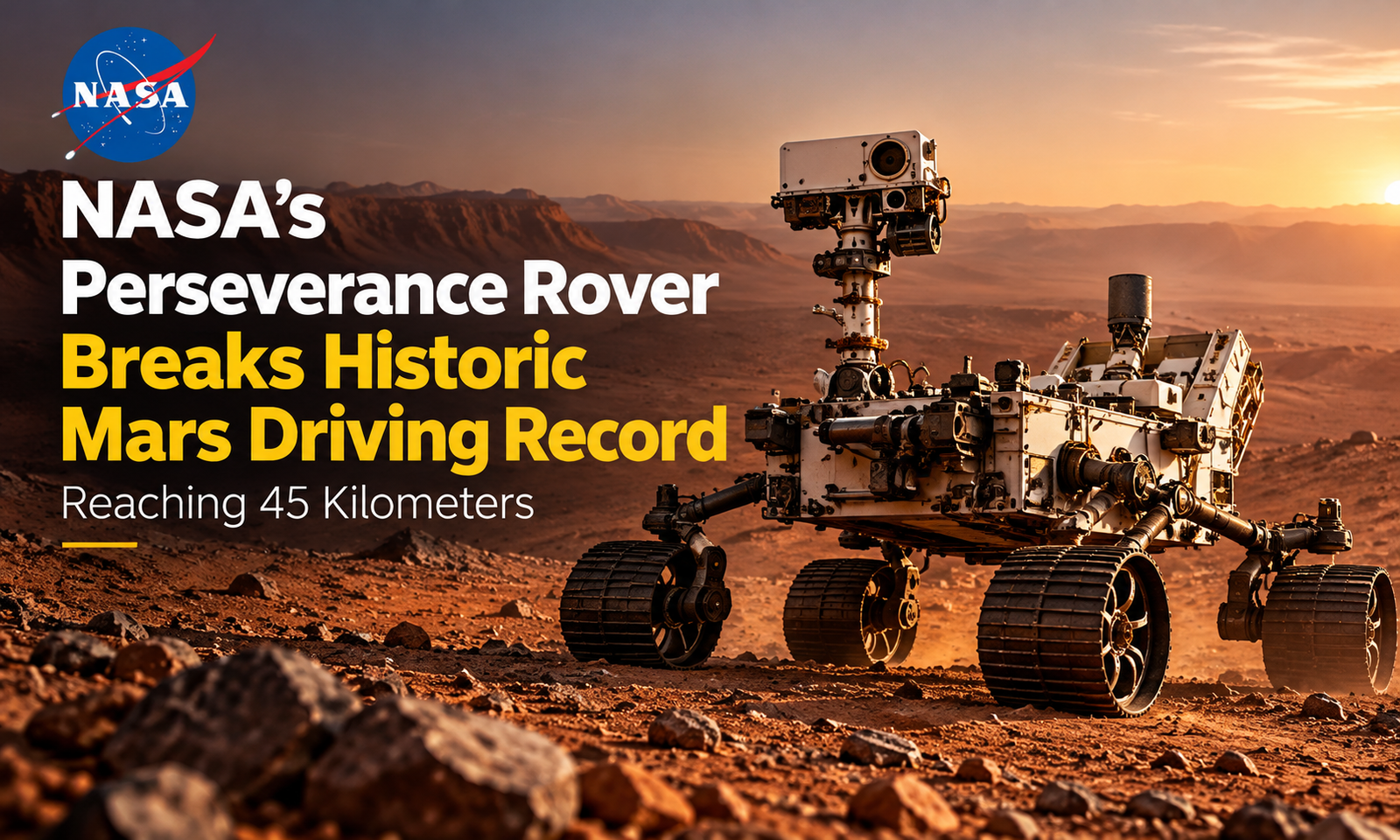
NASA’s Perseverance rover has officially become the longest-traveling vehicle on another world, marking a major milestone in robotic space exploration.
NASA has achieved another remarkable milestone in space exploration. Its Perseverance rover has officially broken the record for the greatest distance traveled by a vehicle on another celestial body, reaching 45.22 kilometers (28.10 miles) on the surface of Mars.
The historic achievement took place on October 11, 2026, surpassing the previous record held by NASA’s Opportunity rover, which traveled 45.16 kilometers during its mission.
What makes this accomplishment particularly impressive is the time required to reach it. While Opportunity spent nearly 15 years exploring Mars, Perseverance achieved its record in approximately five and a half years.
A New Chapter in Mars Exploration
Perseverance landed on Mars on February 18, 2021, with an ambitious mission: explore the planet’s geological history, investigate environments that may once have supported microbial life, and collect samples for potential future scientific analysis on Earth.
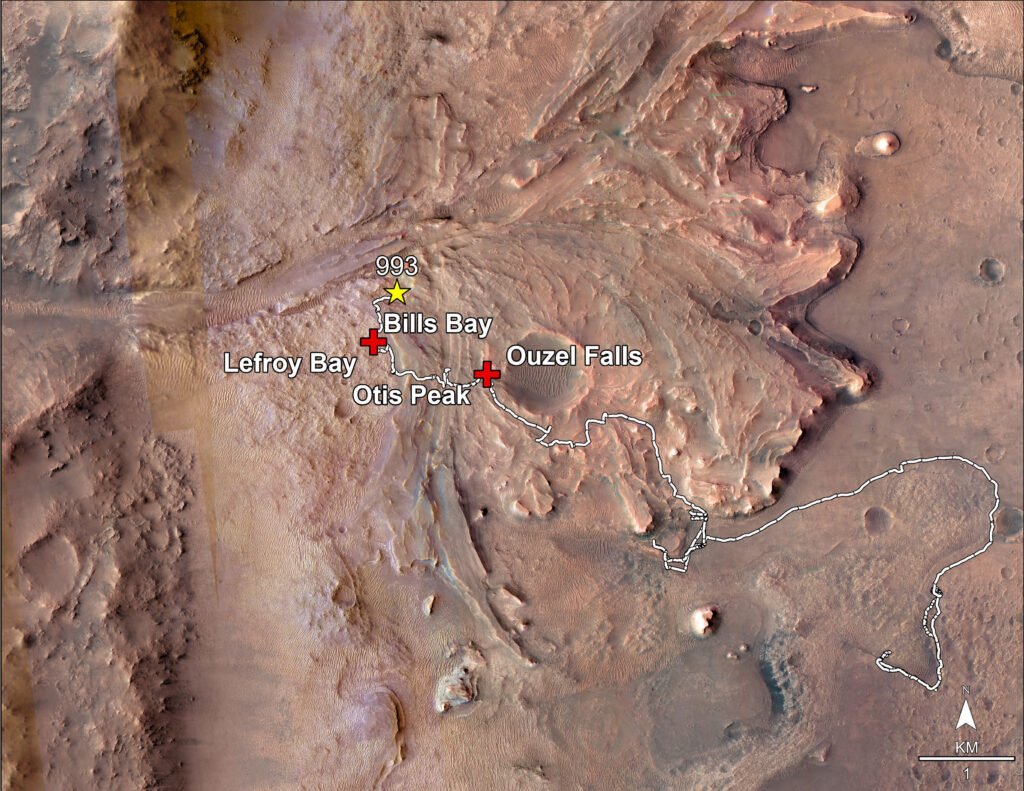
The rover has spent much of its mission exploring Jezero Crater, a region scientists believe contained an ancient lake billions of years ago.
Its latest milestone occurred while traveling beyond the crater’s western rim, toward an area known as Idubi.
The terrain in this region could reveal important information about the early history of Mars and the geological processes that shaped the planet.
How Perseverance Travels Across Mars
Operating a robotic vehicle millions of kilometers away from Earth presents extraordinary engineering challenges.
Communication delays make continuous remote driving impractical. Instead, engineers provide navigation objectives, allowing the rover to evaluate its surroundings and move safely.
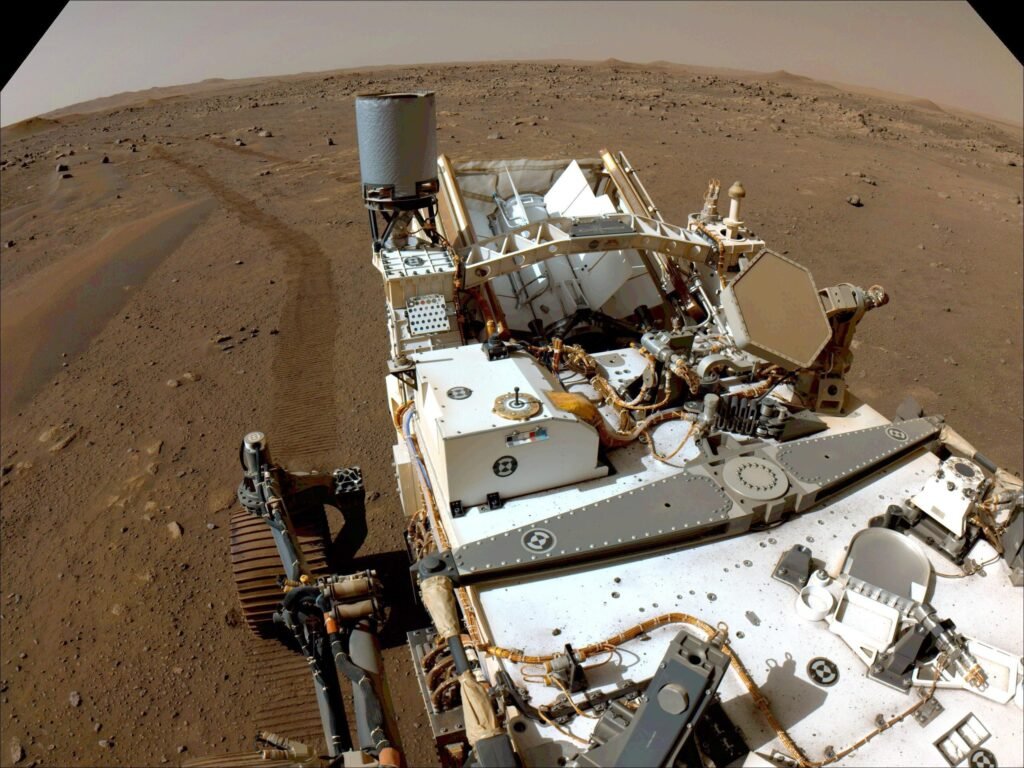
Perseverance uses a sophisticated autonomous navigation system called AutoNav.
The system enables the rover to:
- Capture stereo images of the surrounding terrain.
- Generate three-dimensional maps of nearby obstacles.
- Identify potential hazards and determine safe routes.
- Navigate challenging landscapes with limited human intervention.
According to NASA, more than 90% of the rover’s total driving distance has been completed using autonomous navigation.
The technology represents a substantial improvement over earlier Mars rovers and demonstrates the growing sophistication of robotic exploration systems.
Why This Record Matters for Space Technology
The achievement goes far beyond the distance traveled.
Perseverance demonstrates how advancements in robotics, embedded computing, mechanical engineering, and autonomous navigation can expand humanity’s ability to explore environments that are inaccessible to humans.
Its engineering improvements include more durable wheels, faster onboard processing, advanced navigation cameras, and a power system designed for long-duration missions.
These innovations allow scientists to investigate more locations while reducing the operational limitations that affected previous missions.
The lessons learned could also influence future robotic missions to the Moon, Mars, and other destinations throughout the solar system.
The Search for Ancient Life Continues
Although the distance record is an important achievement, Perseverance’s primary scientific objectives remain unchanged.
The rover continues investigating whether Mars once provided suitable conditions for microbial life.
Scientists are particularly interested in ancient sedimentary rocks and geological formations that may preserve evidence of past biological activity.
In 2025, researchers reported a potential biosignature in Martian rock. However, this finding does not establish that life existed on Mars. Further scientific investigation is necessary.
Perseverance is also collecting carefully selected rock and soil samples that could eventually be examined in laboratories on Earth if a future sample-return mission proceeds.
Could Perseverance Travel 100 Kilometers?
NASA engineers believe the rover may be capable of traveling considerably farther.
Its mobility systems are being evaluated for the possibility of reaching 100 kilometers or more over the course of its operational life.
Mission engineers have also reported that the rover’s major systems remain in excellent condition.
NASA has approved an extension of the mission through approximately 2028, with additional exploration planned around Jezero Crater’s rim.
Some of these regions may contain evidence of ancient hydrothermal environments, where warm water interacted with Martian rocks.
Such environments are especially interesting because they may have provided conditions favorable to life.
The Future of Robotic Planetary Exploration
Perseverance’s record illustrates how far space exploration technology has progressed.
From the pioneering Sojourner rover in 1997 to the sophisticated systems operating on Mars today, each generation of robotic explorers has expanded our understanding of what is technologically possible.
As NASA continues developing advanced mobility systems, scientific instruments, and long-duration spacecraft, robotic exploration will remain an essential part of humanity’s efforts to understand the solar system.
The latest achievement proves that Perseverance is living up to its name — and its journey across the Red Planet is far from over.
Sources: NASA Jet Propulsion Laboratory, Reuters and IEEE Spectrum. Reporting published October 12–14, 2026.